
Come and see; go and tell!
Our prayer for you for this 2026 Synod Gathering has been that you have witnessed and experienced what God has done—and is doing—across our synod and that God has revealed God’s grace through all of it. As we come to our closing worship service this afternoon, it feels natural that we should focus on the “Go and tell” piece of the theme.
It makes me think of Julius Caesar. “I came, I saw….and, no, I didn’t conquer, but I was sent forth to proclaim the good news of Christ.”
The Gospel reading (Matthew 28:16-20 NRSVue) for this service is the assigned reading for tomorrow, Holy Trinity Sunday, but it’s not a bad option for a service of sending (Go and tell!), as it is commonly referred to as the Great Commission—Jesus’ great sending of his disciples. “Go therefore…,” he instructs them.
Again, not a bad reading for a theme of Come and see; go and tell.
The Great Commission. “Great,” meaning significant, massive, important. And “commission,” from co, meaning together, and mission, meaning a sending for a specific task or duty. A sending together. A shared task.
A little later in this service, we will commission our newest synod lay preachers. We will send them, together as a group, but also with the rest of the church, to proclaim the good news of salvation and reconciliation, boldly, with wisdom and patience and with love and faithfulness. A sending together. A shared task. I think they will be relieved to know that they don’t go alone. Right? (directed to the lay preachers)
When I think of being commissioned to do something, my mind wanders back to my first call and a youth mission trip to the mountains of West Virginia. Our youth group had joined a larger group of youth from across the country for a week doing various projects. We were divided into groups and sent to various sites.
On the first day, the van dropped my group off—maybe seven youth and two chaperones—at a home that needed a new set of steps with a small landing, leading up to the front door. We got out of the van and found, waiting for us, a pile of lumber and two stair stringers.
This is when you’re supposed to say, “What else, Bishop Emily? What other supplies did they leave for you? What instructions?”
Ha! Well, that was about it, though there was a set of instructions that, eventually, the resident goat decided to eat. The youth entertained themselves for a while as I sat down on top of all that lumber, trying to make sense of these instructions with no prior experience in building…well, anything. Even my IKEA furniture builds always ended up with a few too many extra parts.
I couldn’t believe that they expected me to lead this group of youth in building a set of stairs. I could make no sense of the instructions or the pieces of wood they left for me. And that van was long gone. And eventually, like I said, the goat ate the instructions. There was nothing I could do but sit there and wait. I knew that if I attempted to start this project myself, it was going to end poorly, and somebody was most definitely going to get hurt. So I just sat there along with the rest of the group, hoping for one of the people really in charge to show up so that I could explain how inadequately qualified we were for this job. Maybe they would reassign us to something I knew how to do, like painting.
After a while, the van came back, and another work group filed out of the car, along with that group’s adult chaperones. Imagine my relief when, after assessing the situation, I discovered that one of the other chaperones was a licensed contractor.
Pretty soon, he got us going, giving us instructions about what boards needed to be cut, which needed to be nailed together, and, believe it or not, by the end of the week, we had built a reliable set of stairs. But, not only could one person not have completed that task alone, not even one group could have done it alone. It wasn’t until someone showed up with the skills the rest of us lacked that we could actually complete, together, the mission. It was, in the fullest sense of the word, a co-mission. A shared task. A sending together.
This mission trip experience aside, there was a time in my life when I was uncomfortable with shared tasks. I didn’t like the feeling of inadequacy. I felt like, to prove my worth, I really needed to do everything on my own. I didn’t like group projects in school. It either felt like I was cheating, by not doing the whole thing myself, or like I was compromising by trusting other people to do something perhaps not quite to my standards.
And then my husband had spinal surgery. Two weeks before we would bring home a baby to adopt without any advanced notice. I remember sitting in my husband’s hospital room as he recovered from surgery, trying to take care of him and frantically creating some semblance of a baby registry.
It’s probably not a coincidence that while I was in the waiting room during my husband’s surgery, I looked down at my feet and was literally wearing two different shoes. Clearly, I could not do it all by myself.
I remember the nerve it took to call my neighbor to ask, “Would you mind going over to my house and just switching the laundry from the washer to the dryer?” Of course, she didn’t mind, and when I got home that night, not only had all the laundry been washed, dried, and neatly folded, but the dishes in the sink had also been washed, dried, and put away.
That, too—caring for my husband and preparing for a baby—turned out to be a great co-mission. A shared task. A sending together.
This Great Commissioning text is used for Holy Trinity Sunday, presumably because it’s one of the few places in the Bible that mentions all three persons of the Holy Trinity:
Go therefore and make disciples of all nations, baptizing them in the name of the Father and of the Son and of the Holy Spirit and teaching them to obey everything that I have commanded you. And remember, I am with you always to the end of the age. (Matthew 28: 19-20 NRSVue)
It’s always so tempting to try to explain away the Holy Trinity on this Sunday. The Trinity is like this or like that. But you all know that any attempt to explain it fails in the end.
So instead of trying to figure it all out, I wonder if it’s not enough to recognize that not even God undertakes the divine work alone. Three in one; one in three. Intrinsic to God’s very nature is a co-mission—a shared task.
And perhaps if we are created in the image of God, then we, too, are created to do this work to which we are called together, in community with one another. Perhaps we’re actually supposed to ask for something when we have a need, and to offer something when we have an abundance. Perhaps we are not supposed to feel threatened by the gifts of one another, but rather to feel grateful that someone can do what we cannot and that we can do what they cannot. Perhaps we are supposed to share the task to which we are called and the mission for which we are sent.
If we try to go it alone, we won’t get very far; we won’t have what we need. But when we recognize that we are co-missioned, that we are tasked with collaboration, we will have everything that we need.
We do not have to do this work alone. In fact, I am convinced that we are not supposed to do it alone. We have one another. And we have God, who promised also to be with us all the way to the end of the age.
Amen.
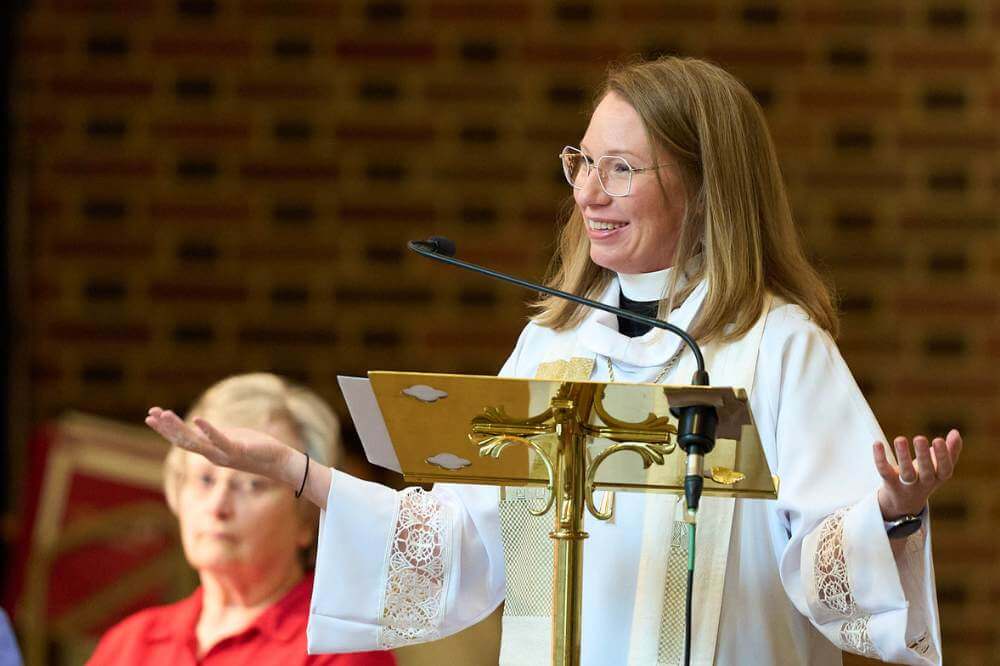
This sermon was preached by Bishop Emily K. Hartner on Saturday, May 30, in Grace Chapel at the closing worship of the 2026 Synod Gathering of the North Carolina Synod, held at Lenoir-Rhyne University, Hickory, NC.
Walking with you,